
Chromatic earth mixtures
How to mix brown acrylic paint from primary colors
Brown is a dark, low-chroma orange family rather than one fixed recipe. Mixing it from color gives control over warmth, undertone and shadow relationships. The clearest method is to build an orange direction, then neutralize and darken it with blue.
Start here
The short answer
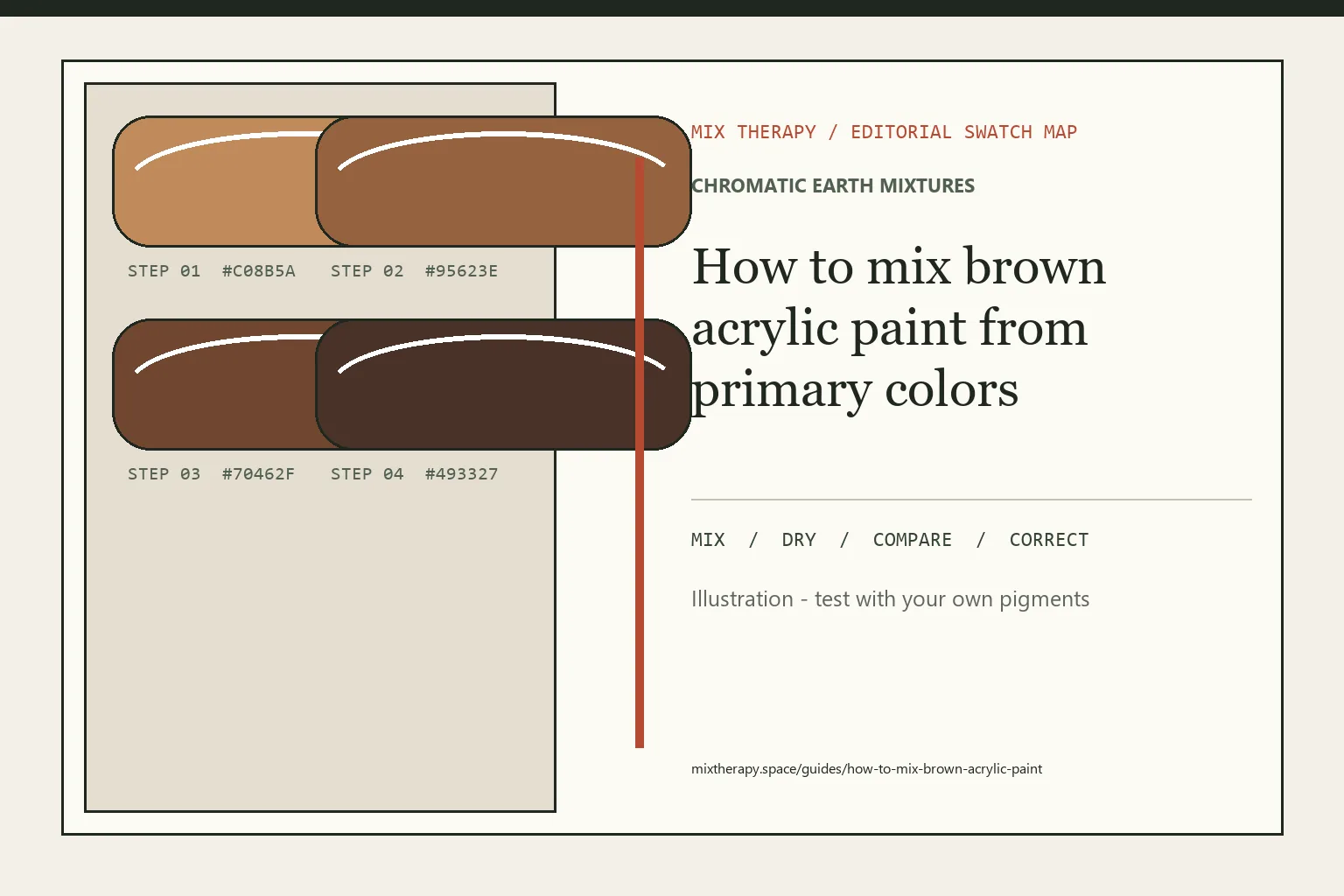
Mix yellow and red into an orange, then add blue gradually until the chroma drops into brown. More red and yellow make a warmer brown; more blue creates a cooler, darker brown. Alternatively, combine a complementary pair such as ultramarine and burnt sienna. Check a thin spread and tint to see the undertone.
Brown directions
Think beyond one generic brown
The subject determines whether brown should lean orange, red, yellow, violet or gray.
| Brown family | Bias | Useful route |
|---|---|---|
| Warm leather | Red-orange | Orange base plus restrained blue. |
| Golden wood | Yellow-orange | Yellow ochre plus sienna. |
| Cool soil | Blue-violet | Earth base plus ultramarine. |
| Deep umber | Low value neutral | Complementary pair near balance. |
Convenience earth colors are valuable. Mixing from primaries is a control exercise, not a requirement to replace every earth tube.
01
Identify the undertone in the target
Wood, soil, hair and leather contain different brown families. Compare the target with orange, red and yellow references and decide which relationship is strongest. Then check whether the color is light, middle or deep in value.
A photograph may introduce warm indoor light or cool sky reflection. Sample a midtone and keep highlight and shadow recipes separate so the local brown is not distorted by illumination.
02
Build an orange foundation
Combine yellow and red into an orange that leans toward the target. A warmer red gives a clearer orange; a blue-biased red starts closer to a neutral because its bias already opposes yellow-orange. Mix completely before adding blue.
Keep a clean portion of the orange aside. It can restore warmth if the neutralization overshoots and can become the light family without reopening the original tubes.
03
Add blue to lower chroma and value
Introduce blue with the tip of a knife and watch the orange move through muted rust into brown. Ultramarine usually creates a natural violet-brown route; phthalo blue is stronger and can push the mixture cool very quickly.
Stop after each addition and spread a thin edge. The mass tone may look nearly black while the drawdown reveals a rich warm or cool brown. Add more blue only when both value and undertone need that direction.
04
Create light and shadow branches
For lighter wood or skin-adjacent earths, add yellow, orange or white according to the target. White reveals undertone but can make brown look pink or gray, so restore a small amount of the warm base as value rises.
For deep shadows, move the complementary pair closer to neutral and keep a bias toward the local brown. A perfectly neutral black can feel cut out from a warm object unless reflected or local color returns around it.
05
Use earth tubes as calibrated shortcuts
Burnt sienna, raw sienna, burnt umber and yellow ochre provide repeatable pigment characteristics that a three-primary mixture may not match exactly. Compare the mixed brown with a convenience earth and choose based on opacity, transparency, drying appearance and palette unity.
Record both routes when useful. A tube earth can set the base while a primary or complementary mixture steers its temperature without requiring another purchased color.
Troubleshooting
Steer a mixed brown deliberately
Use the saved orange base to recover from over-neutralization.
| Symptom | Direction needed | Correction |
|---|---|---|
| Looks orange | More neutral or cool | Add blue in a small measured amount. |
| Looks gray | More warm chroma | Restore clean orange base. |
| Looks purple | More yellow-orange | Add yellow and a little warm red. |
| Light brown looks pink | More yellow warmth | Add yellow ochre or yellow-orange base. |
Free studio printables
Record the test instead of guessing again.
Use the worksheet beside the palette, then keep the dry result with the painting notes. Each PDF is free, low-ink and formatted for US Letter paper.
See both printables and the full methodStudio questions
Questions painters ask
What primary colors make brown?
Yellow and red make orange; adding blue gradually neutralizes that orange into brown. The exact balance controls the undertone.
Why does my brown turn gray?
The complementary colors are too evenly neutralized for the intended target. Add clean orange, red or yellow to restore a useful warm bias.
Is mixed brown better than burnt umber?
Not universally. Mixed brown offers adjustable relationships; burnt umber provides convenient and repeatable handling. Many painters use both approaches together.