
Color-mixing diagnosis
Why acrylic colors turn muddy and how to fix them
A muddy mixture is not simply a dull color. It is a color whose hue, value or chroma no longer serves the painting. The practical fix begins by naming which property was lost, then rebuilding with fewer pigments instead of adding another rescue color to an exhausted pile.
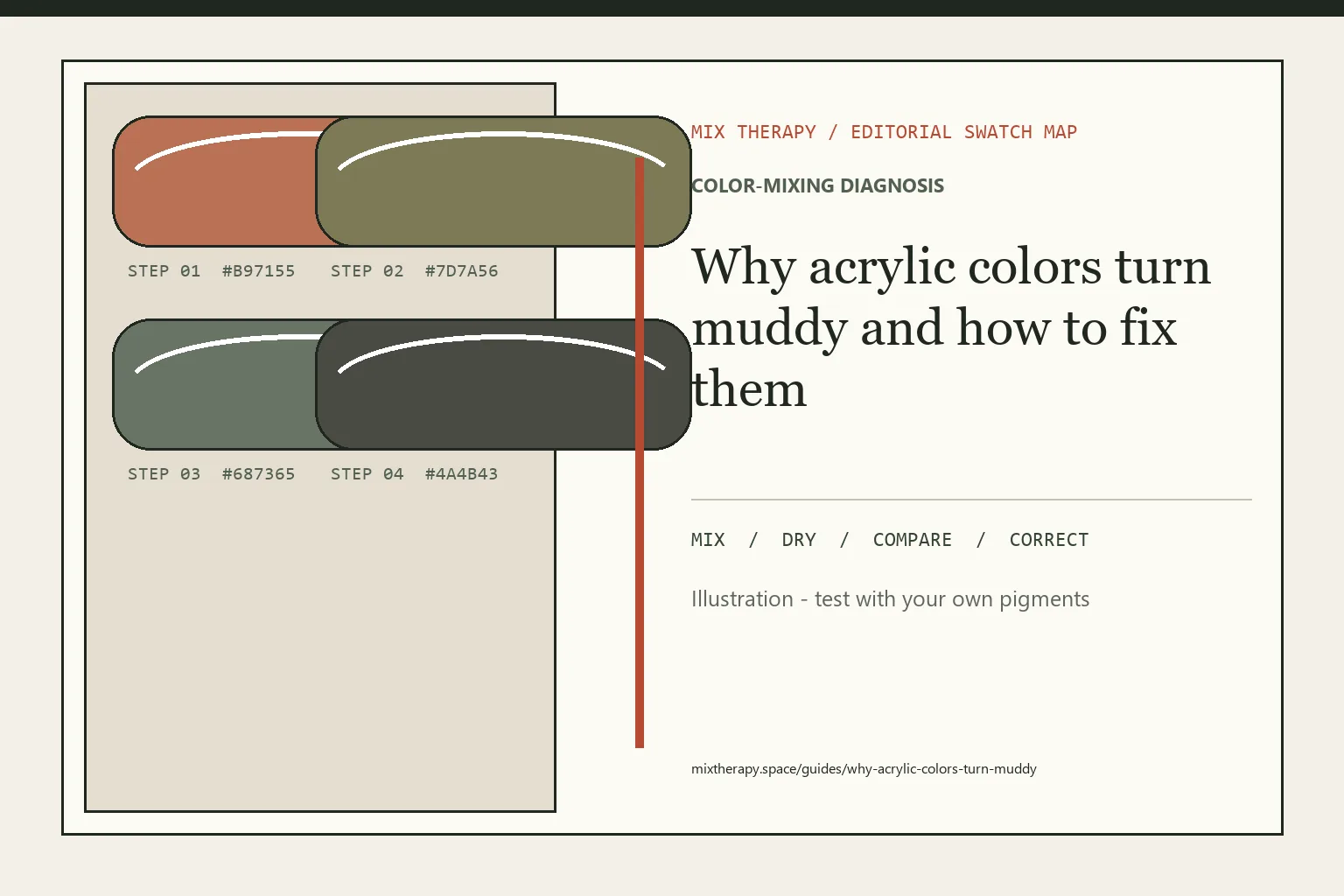
Start here
The short answer
Acrylic mixtures usually become muddy because too many pigments are combined, a complement is added too quickly, dirty tools contaminate the pile or the value is wrong and gets mistaken for low saturation. Stop adding paint, spread a thin test to reveal the undertone and rebuild from a clean dominant color. Neutralize with one measured complement only after hue and value are close.
Four checks
Find the cause before changing the pile
The word muddy hides several different problems. Each one needs a different correction.
| Visible problem | Check | First move |
|---|---|---|
| Hue disappeared | Too many pigments | Restart with the dominant hue and one modifier. |
| Color looks dirty | Brush or knife contamination | Clean tools and remix a small fresh pile. |
| Color looks dull | Complement overshot | Restore with clean base color, not white. |
| Color looks heavy | Value is too dark | Compare in grayscale before changing chroma. |
A useful neutral can contain low chroma and still be clear, intentional and related to the surrounding palette.
01
Define what muddy means in this painting
Place the suspect mixture beside the target and describe the largest difference: too gray, too brown, too dark, too cool or simply unrelated to nearby colors. A neutral shadow may be exactly right even though it looks dull on a white palette. Context decides whether low chroma is a problem.
Check value separately by squinting or using a grayscale reference. Painters often add more saturated color when the real error is that the mixture is too dark. That extra pigment increases complexity without solving the relationship.
02
Count pigments, including mixtures already on the brush
Every commercial tube may contain one pigment or several. Combining three convenience colors can quietly put six or more pigments into one pile. More pigments do not automatically make mud, but they make the route back to a clean hue harder to understand.
Read the color-index codes on the labels and begin with the smallest useful pair. Clean the palette knife between additions, keep rinse water fresh and avoid pulling a contaminated brush through a light mixture. These simple controls remove many accidental neutrals.
03
Neutralize in measured stages
To lower chroma deliberately, mix a small neutralizing concentrate from the target hue and its complement. Add that concentrate to a clean base in tiny increments. This gives more control than dropping a strong red directly into a large green pile or adding black by habit.
Stop and make a drawdown after each meaningful addition. Thick paint can hide the undertone, while a thin edge reveals whether the mixture is drifting brown, violet or green. Reserve a clean portion of the base so an overshoot can be corrected without opening more tubes.
04
Know when to rescue and when to restart
A slightly over-neutralized mixture can often be restored with fresh dominant color. A pile containing many unrelated pigments, too much medium or repeated white-and-complement corrections is usually cheaper to replace. Save it as a background neutral if it has a clear use, but do not spend ten minutes forcing it into a high-chroma accent.
When restarting, write down the failed route. A note such as “red earth overwhelmed yellow-green at one knife tip” turns waste into calibration and makes the second batch faster.
05
Keep mixtures connected across the painting
Mud is less likely when each color family grows from a limited set of shared pigments. Use a clean local base for lights, halftones and shadows, then bias each branch rather than mixing every passage independently. Shared ingredients create harmony without making every pile identical.
Let test strokes dry on the actual ground. Acrylic dry shift, gloss and surrounding colors can make a controlled neutral appear dirtier or cleaner than it looked wet on the palette.
Troubleshooting
Recover a mixture without guessing
Use the smallest correction that addresses the visible error.
| Symptom | Likely cause | Controlled correction |
|---|---|---|
| Green became brown | Too much red or warm earth | Rebuild from clean yellow and blue, then neutralize more slowly. |
| Pastel looks gray and chalky | Too much white after over-neutralizing | Restore the hue in a separate pile before adjusting value. |
| Mixture changes every stroke | Dirty brush or uneven mixing | Clean tools and combine measured parts completely. |
| Dry swatch is duller than wet pile | Film, surface or light changed | Repeat on the final ground under stable light. |
Free studio printables
Record the test instead of guessing again.
Use the worksheet beside the palette, then keep the dry result with the painting notes. Each PDF is free, low-ink and formatted for US Letter paper.
See both printables and the full methodStudio questions
Questions painters ask
Does mixing all three primary colors always make mud?
No. Three primaries can create useful browns, grays and chromatic darks. They become a problem only when the result does not match the intended hue, value and chroma.
Can white fix a muddy acrylic color?
White raises value and reveals undertone, but it does not restore lost chroma. Rebuild with clean dominant color first, then use white only if the target also needs to be lighter.
Is black the main cause of muddy paint?
Not by itself. Black can cool, mute or darken a mixture depending on the pigment. The common problem is using it before identifying whether value or chroma actually needs correction.