
Violet and pastel mixing
How to mix lavender purple acrylic paint
Lavender is a light violet that may lean blue, pink or gray. The quality of the starting violet matters more than the amount of white: a yellow-biased red or blue can neutralize the pair before the pastel is even created.
Start here
The short answer
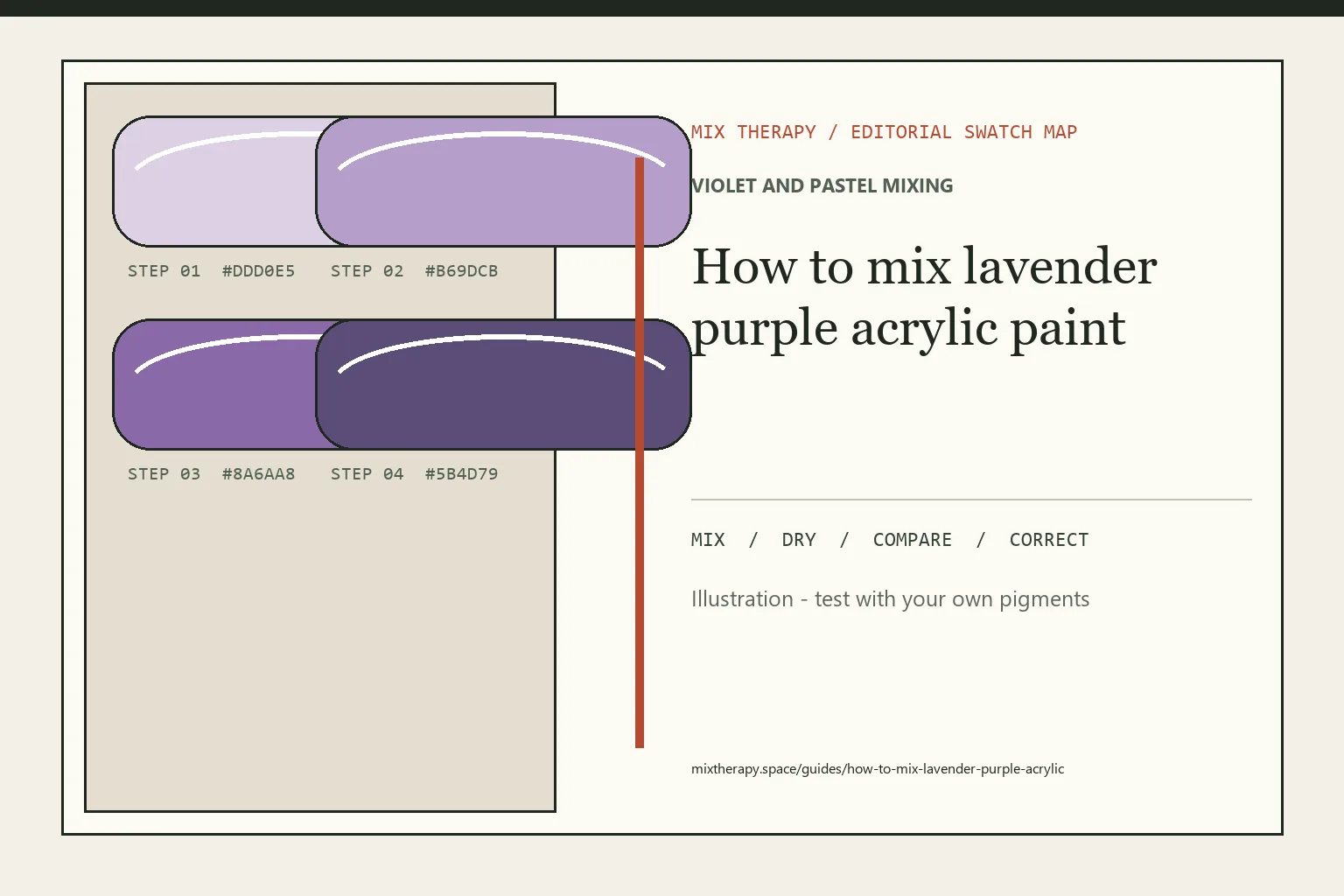
Mix a clean violet from a blue-biased red or magenta and ultramarine blue, then pull a small amount into titanium white. Add more blue for a cool lavender, more magenta for a pink lavender and a trace of yellow ochre for a muted floral version. Make the violet first; do not try to balance red and blue separately inside white.
Lavender controls
Start with the right violet
White reveals the undertone already present in the dark mixture.
| Result | Adjustment | Avoid |
|---|---|---|
| Cool lavender | More ultramarine | Too much black. |
| Pink lavender | More magenta | Warm orange-red. |
| Muted lavender | Trace of yellow ochre | Full-strength yellow. |
| Deep shadow | Violet plus chromatic dark | White-heavy gray. |
Check tube labels. A convenience purple containing white will behave differently from a transparent single-pigment violet.
01
Choose pigments that can reach violet
A red that leans toward orange carries a yellow bias, and yellow opposes violet. It will naturally mute the mixture with blue. For a clearer violet, choose a magenta or blue-biased red and pair it with ultramarine or another violet-biased blue.
Muted pigments are useful when the target is dusty lavender, but know whether the restraint comes from pigment bias or from a deliberate complement. That knowledge makes later corrections predictable.
02
Mix and evaluate the violet concentrate
Combine the red and blue before adding white. Spread a thin edge to reveal whether the mixture leans red or blue. A mass-tone violet can look almost black, so tint a tiny sample temporarily if the undertone remains unclear.
Save two branches when painting flowers or fabric: one slightly warmer and one slightly cooler. Their relationship creates form more naturally than lightening and darkening one uniform purple.
03
Pull violet into white
Place titanium white separately and introduce the violet concentrate in small amounts. White has strong covering power but the violet may also be powerful, especially with quinacridone or dioxazine pigments. Mix completely before judging the hue.
If the lavender becomes chalky, it may have too much white for the target chroma. Add concentrate rather than black. Then make a dry swatch because acrylic pastel values can settle differently from the wet palette.
04
Mute with a controlled yellow opposition
For dusty lavender, make a small yellow-ochre modifier and add only a trace. Yellow is violet’s complement and can move a clean pastel rapidly toward gray or beige. An earth yellow provides more control than a high-chroma lemon yellow.
If the mixture overshoots, return to a clean violet-and-white branch. Alternating yellow and violet repeatedly in the same pile often creates a generic neutral rather than a nuanced floral color.
05
Build shadows without losing color
Lavender shadows are not always lavender plus black. Deepen with a more concentrated violet, a little ultramarine or a chromatic dark related to the setting. Preserve reflected warm or cool color from the surroundings.
Test the family together on the painting ground. A blue lavender beside warm green may appear much cooler than it did on white, while a pink lavender beside red can look unexpectedly gray.
Troubleshooting
Fix a lavender that missed the target
Return to a clean violet branch when complements have overshot.
| Symptom | Likely cause | Correction |
|---|---|---|
| Violet looks brown | Warm red or yellow contamination | Use a blue-biased red and clean tools. |
| Lavender looks pink | Too much red or not enough blue | Add violet concentrate biased toward blue. |
| Lavender looks chalky | Too much white | Increase clean violet concentrate. |
| Muted mix looks beige | Yellow complement overshot | Restart from clean violet and white. |
Free studio printables
Record the test instead of guessing again.
Use the worksheet beside the palette, then keep the dry result with the painting notes. Each PDF is free, low-ink and formatted for US Letter paper.
See both printables and the full methodStudio questions
Questions painters ask
What colors make lavender acrylic paint?
Mix a blue-biased red or magenta with ultramarine to make violet, then add that violet to titanium white.
Why does red and blue make brown instead of purple?
One or both paints may lean toward yellow, the complement of violet, or the tools may contain yellow contamination. Check pigment bias and clean the palette.
How do I make dusty lavender?
Add a tiny amount of yellow ochre to a clean lavender. Stop while the violet identity is still visible.