
Choose white for the passage
Titanium white vs zinc white in acrylic paint
For an opaque highlight or a pale mixture that needs to cover, start by checking a titanium white rated opaque. For gentler lightening where the underlying color should remain visible, consider zinc white or a transparent mixing white. Then read the exact paint range, pigment list and opacity: “mixing white” does not always mean zinc, and PW6 does not guarantee the same coverage in every formulation.
Start here
Should you use titanium white or zinc white in acrylics?
Choose by the job: an opaque titanium white is a useful first candidate for covering passages and pale tints; zinc white or a transparent mixing white is worth comparing for subtle adjustments and more translucent passages. Check the exact product before choosing. GOLDEN Heavy Body Titanium White is listed as PW6 and opaque; its Zinc White is PW4 and semi-transparent. Those ratings describe those products, not every tube with the same pigment code.
Choose by painting task
What do you need the white to do?
Start with the passage you are painting, then check the candidate on your own surface.
| Your aim | First candidate to check | Deciding observation |
|---|---|---|
| Cover a darker layer with a pale stroke | A white rated opaque | Does the dry stroke hide enough at your working thickness? |
| Lighten a color gently | Zinc or transparent mixing white | Can you reach the adjustment without an unwanted pale result? |
| Keep an underlying mark visible | A white rated transparent or semi-transparent | Does the mark remain visible in the applied mixture? |
| Repeat an existing recipe | The original white and paint range | Does a substitute reproduce both color and coverage? |
These are starting decisions, not tested recipes. Neither a product name nor a pigment code replaces the application check.
01
Separate lightening from covering
A mixture can be light enough on the palette and still show the dark layer beneath it. Conversely, a white can hide an underlying mark while making the color paler than you wanted. Decide which result matters before changing the recipe: a covering cream-colored highlight and a translucent light veil are different painting tasks.
For example, if you want a cream highlight over a brown passage, check both the cream color and whether the brown shows through. If you want a thin light passage over a drawn line, decide how much of that line should remain visible. These examples describe choices to test, not physical mixtures we have made or formulas that suit every tube.
02
What titanium and zinc whites offer
GOLDEN lists its Heavy Body Titanium White, item 1380, as titanium dioxide rutile, PW6, with an opaque rating. Its Heavy Body Zinc White, item 1415, contains zinc oxide, PW4, and is rated semi-transparent; the manufacturer describes it as an option for mixing and glazing. This pair gives a concrete comparison within one paint range. It does not establish identical behavior across brands or other acrylic ranges.
GOLDEN’s Just Paint article “Neutralizing Color” explains that adding Titanium White changes value and opacity as well as saturation; further additions move the mixture toward a pastel appearance. It describes Zinc White’s weaker tinting strength as useful for subtle toning. That is the practical reason to compare a gentler white when a small adjustment keeps overshooting your target.
Neither is the winner for every painting. A strong covering white can be useful when you want a deliberately pale, opaque color. A gentler mixing white may give you a more manageable path to a small change. The useful choice is the one that reaches the intended color and layer effect with the paints you have.
03
“Mixing white” does not always mean PW4
Read the complete product identity before using the name as a substitution rule. Liquitex’s Transparent Mixing White article identifies PW4 in its Heavy Body and Soft Body versions, while its Basics version is based on PW6. The article describes the product family as translucent with subtle tinting strength. This is a direct example of why titanium pigment does not make every formulated white a covering white.
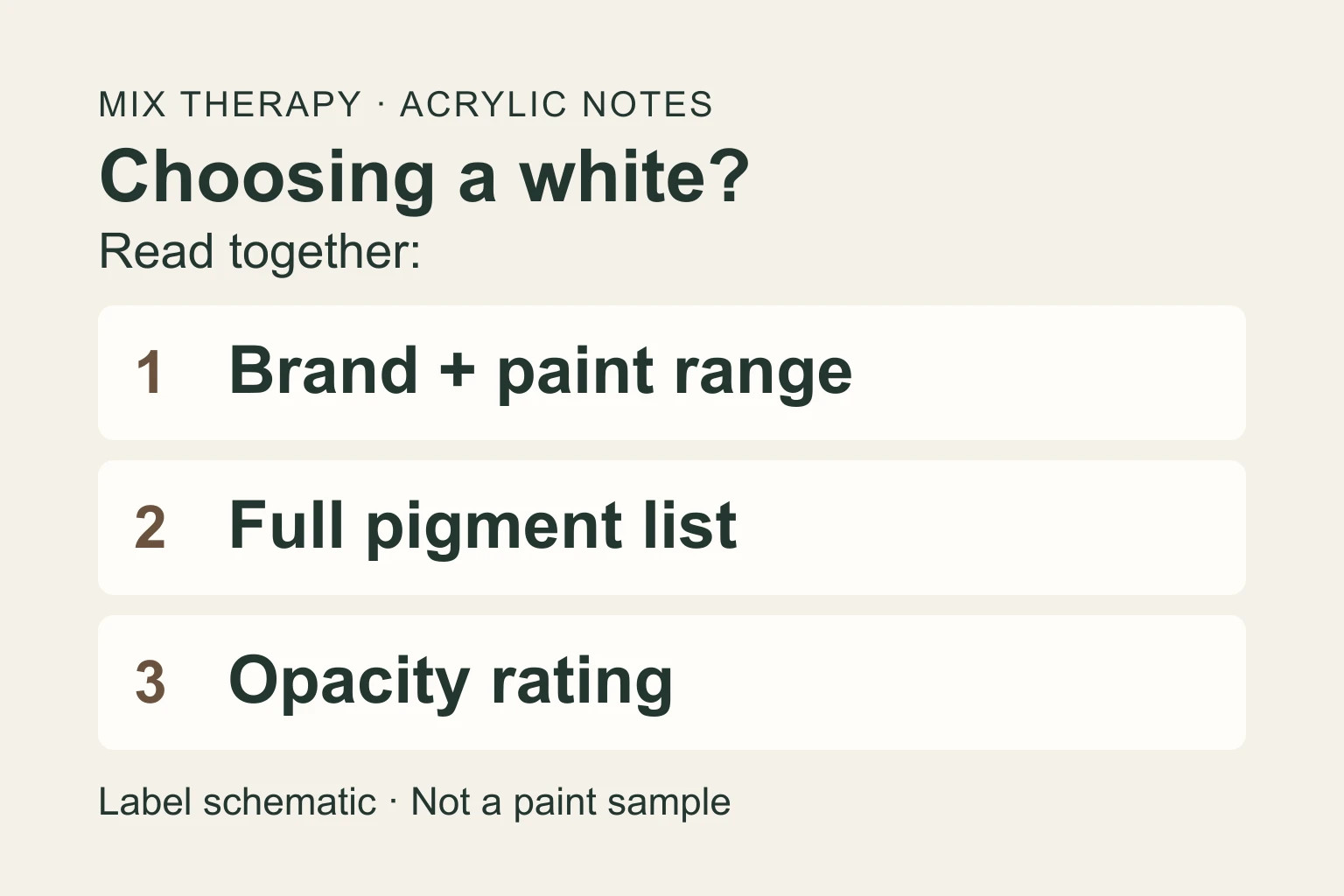
Keep three fields together in your notes: brand and range, complete pigment list, and the manufacturer’s opacity description. If the label lists both PW4 and PW6, retain both rather than filing it under zinc or titanium alone. If the information is missing, check the official page for that exact range. Our pigment-code guide covers the general label vocabulary; here the decision is whether this particular white suits your intended passage.
04
Compare the whites you already own in two stages
Choose one colored paint you actually plan to lighten and two candidate whites. Label the exact tubes A and B. Prepare a spare surface like the painting, including a light area and a dried dark mark that crosses both comparison areas. Use a clean tool and comparable application thickness for each white. First apply each white by itself across the mark and let the samples dry. Record how much of the mark you can see.
Next, set aside equal measured portions of the same colored paint. Add equal measured portions of A and B to separate portions, using one consistent measurement method. Keep an untouched portion of the colored paint as a reference. Spread the mixtures across the light area and dark mark at comparable thickness, then compare after drying. This first stage asks what the same addition does; it does not assume the two whites should make the same tint.
For the second stage, make fresh trials and adjust each toward the same intended lightness. Record the additions separately. Compare the dry trials for hue, coverage and visibility of the underlying mark. This asks the more useful painting question: once each mixture is light enough, does it still have the layer effect you need? Do not judge transparency from samples with markedly different lightness or thickness and assume white identity explains everything.
Keep any medium and its amount consistent during the comparison, following its instructions. If the whites come from different ranges, note differences in consistency and handling as additional variables. The result helps choose between your tubes under those conditions; it is not a measurement of pigment strength or a universal ranking.
05
Adapt a recipe when the white changes
Replacing an opaque titanium white with a gentler white is a new trial, not a simple name change. Begin with a fresh small portion of the colored mixture and add the substitute gradually. Compare it with the original dry sample if you have one. Check lightness and coverage separately: reaching a similar lightness does not demonstrate that the mixture will hide the same underlying layer.
In the reverse direction, add an opaque white cautiously when replacing a subtle mixing white. If the trial becomes too pale or hides a mark you wanted to retain, start another small portion with less white rather than repeatedly correcting the whole batch. There is no conversion factor supplied here between PW4 and PW6, or between different brands’ mixing whites.
For a cream recipe, record which white made the base before noting the yellow or other modifying colors. A substitute can change how much adjustment is useful. Once a new trial works, save it as a separate recipe with its white, range, quantities, measurement method and dry sample. Only then scale that recorded mixture using the related ratio guide.
06
Decide whether you need another tube
If the white you own gives the coverage and tint you need, keep using it. If a tiny addition repeatedly makes a mixture too pale, compare a smaller addition first; a gentler mixing white becomes a useful candidate when that adjustment remains awkward. If your intended opaque highlight still shows the layer below, check application thickness and the product’s opacity information before buying a white by name alone.
Save the comparison beside the painting notes. A note such as “A covered the dark mark at my highlight thickness; B kept it visible at the target lightness” is more useful than calling one white better. It states the reason for choosing a tube without turning a local observation into a claim about all acrylic paints.
Troubleshooting
When the white changes the wrong thing
Use the symptom to choose the next small comparison.
| What you see | What to check | Next step |
|---|---|---|
| Tint becomes too pale quickly | White addition and tinting behavior | Try a smaller addition; compare a gentler white if needed. |
| Pale stroke still shows the dark layer | Opacity rating and application thickness | Check a covering white at the intended thickness. |
| New mixing white behaves differently | Exact range, full pigment list and opacity | Treat the replacement as a fresh recipe trial. |
| Two trials look equally light but cover differently | Underlying mark and comparable thickness | Choose the layer effect needed for the painting. |
Free studio printables
Record the test instead of guessing again.
Use the worksheet beside the palette, then keep the dry result with the painting notes. Each PDF is free, low-ink and formatted for US Letter paper.
See both printables and the full methodSources and product references
- GOLDEN: Heavy Body Titanium White — Item 1380: PW6 titanium dioxide rutile and the product’s opaque rating.
- GOLDEN: Heavy Body Zinc White — Item 1415: PW4 zinc oxide, semi-transparent rating and mixing/glazing use.
- Liquitex: Transparent Mixing White — Different pigment choices across ranges under the same product name, and the intended subtle tinting role.
- GOLDEN Just Paint: Neutralizing Color — The White section discusses value, opacity, pastel effects and gentler toning with Zinc White.
Studio questions
Questions painters ask
Do I need both titanium white and zinc white?
Only if they solve different tasks in your painting. Check whether the white you own already gives the tint and coverage you need. Compare a gentler white when small lightening adjustments remain difficult, rather than buying both by default.
Can I replace titanium white with zinc white one for one?
Do not assume an equal amount will reproduce the same color and coverage. Make a small separate trial with the exact substitute, record its additions and compare the dry result before scaling it. This guide supplies no universal conversion ratio.