
From test swatch to paint batch
How to scale acrylic paint mixing ratios
To make more of a recorded acrylic mixture, multiply every ingredient by the same factor. To make a chosen total amount, divide that total by the sum of the recipe’s parts, then multiply each ingredient’s parts by the result. Keep the same paints and measurement method. The calculation preserves proportions; a dry trial checks whether the larger mix still works for the painting.
Start here
How do you calculate a larger acrylic paint mixture?
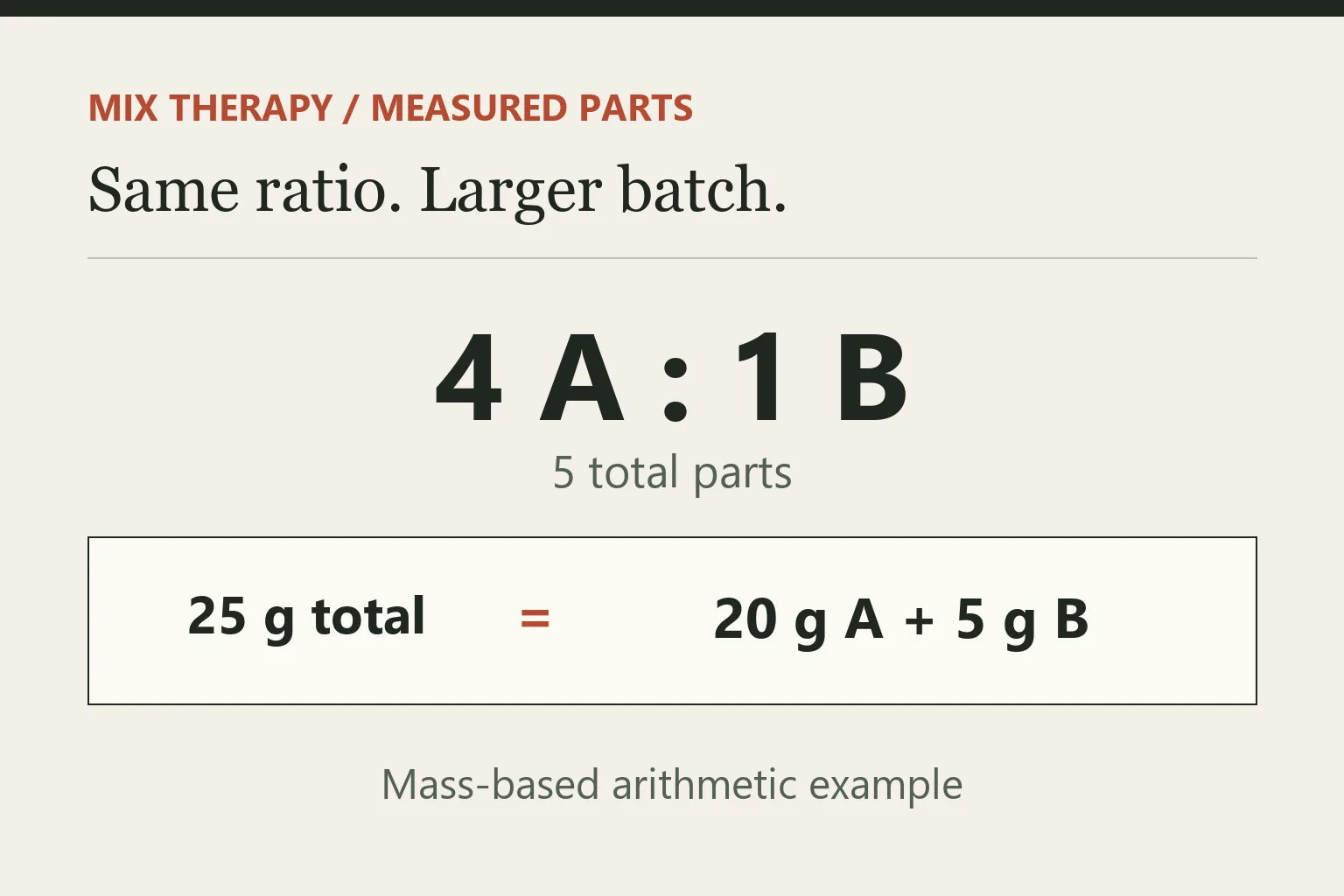
Ingredient amount = desired batch total × ingredient parts ÷ total recipe parts. For a mass-based 4 A : 1 B ratio, there are five total parts. A 25 g batch uses 20 g A and 5 g B. For a volume-based recipe, calculate and measure in volume instead. These quantities preserve the example ratio; they do not identify a particular color.
Worked calculation
The same 4 : 1 ratio at three sizes
A and B stand for two ingredients in a recorded trial. The 4 : 1 input also appears as a blank comparison column in our mixing worksheet; it is not a recipe for a named hue.
| Total | A (4 parts) | B (1 part) |
|---|---|---|
| 10 g | 8 g | 2 g |
| 25 g | 20 g | 5 g |
| 40 g | 32 g | 8 g |
This table assumes a ratio by mass. It does not convert a recipe measured in scoops, drops or milliliters into grams.
01
Start with the recipe you actually checked
Find the note for the small mixture, not just its color name. Copy every ingredient, its brand and paint range, the recorded parts, the white used, and any medium. Keep the dry sample beside the note. If the trial was still being corrected, finish that small comparison before preparing more of it.
Write what one part meant in that trial: a measured mass, a measured volume or an approximate scoop. NIST distinguishes mass units from volume units; grams and milliliters describe different quantities. A note that says only “four blue, one white” leaves the measurement method unresolved. Repeat the original method or establish a new measured trial rather than silently changing it.
02
Add the parts before dividing the batch
In the worked example, four parts A and one part B make five parts altogether. If the chosen batch is 25 g and the original ratio is by mass, one part is 25 ÷ 5 = 5 g. Multiply A’s four parts by 5 g to get 20 g; B’s one part is 5 g. Check the sum: 20 + 5 = 25 g.
The general calculation works with more ingredients too: add all their parts, including white if it belongs to the recorded recipe, then allocate the chosen total in proportion to each ingredient. Do not assign the whole batch amount to the dominant paint and add the remaining ingredients on top; that makes a larger total than the one you planned.
The ratio is also 80 percent A and 20 percent B, because 4 ÷ 5 = 0.8 and 1 ÷ 5 = 0.2. Four parts to one does not mean four percent to one percent. Parts describe a relationship, while the total tells you how much material to prepare.
03
Scale an existing batch without changing its balance
If your measured trial used 8 g A and 2 g B, doubling it means 16 g A and 4 g B. Multiplying it by four gives 32 g A and 8 g B. Use the same multiplier for every ingredient. Increasing only the base paint or only the white changes the recipe rather than scaling it.
Keep the ingredient list unchanged for this first larger trial. A different tube, paint range or white is another variable to check. GOLDEN’s color-mixing guide explains that paints differ in tinting strength. Scaling a recorded ratio is a different task from choosing the ratio that produces a useful hue with your particular paints.
04
Measure the batch with one consistent method
For a mass-based recipe, place a clean mixing container on the scale and zero it before measuring paint. Add the planned amount of A, record it, then zero again before adding the planned amount of B. Alternatively, use cumulative readings: for the 25 g example, the readings would be 20 g after A and 25 g after B. Choose one approach and keep your notes clear.
For a volume-based recipe, keep the same volume unit for all ingredients. If you used approximate scoops for the trial, use the same scoop and filling method for the larger mix. A weight-based trial can be a useful separate record, but do not relabel the old scoop count as grams and assume it is the same mixture.
Check the smallest planned quantity before you start. If your measuring method cannot distinguish it clearly, use a more suitable method or a manageable larger trial. Avoid rounding a small strong-color addition to zero. GOLDEN warns that simplifying the ratios in its virtual mixer can change the displayed color; keeping the original ratio is the starting point for this exercise.
05
Decide what to do when an ingredient overshoots
Suppose the plan was 8 g A plus 2 g B, but you added 3 g B. The mixture now contains 8 g A and 3 g B. To restore the arithmetic 4 : 1 relationship by adding A, you need 12 g A in total, so the additional amount is 4 g. The resulting batch is 15 g, not the original 10 g.
That is a hypothetical calculation, not a report of a paint test. Decide whether the larger amount is useful before adding it. Restoring a ratio by addition increases the batch size; if that extra paint is unwanted, rebuilding the small trial may be more practical. Record what you actually added so a correction does not become an undocumented new recipe.
06
Use the workbench multiplier for a starting recipe
Mix Therapy can suggest a starting mixture from a reference target and the paints you select. After a result appears, open “Other mixes & measurements.” The batch-size control offers 1x, 2x, 5x and 10x; it multiplies each displayed ingredient amount by that factor. The measurement selector changes the displayed unit.
These controls do not turn a previously measured scoop recipe into a calibrated mass or volume recipe. Choose a measurement basis, make a small trial and record what worked. For an arbitrary total such as 25 g, use the calculation above with your checked ratio. A displayed unit or screen prediction is not evidence that the physical mixture matches the reference.
07
Keep the dry check and the batch record together
Mix the measured ingredients thoroughly and paint a small sample on a surface prepared like the artwork. Let it dry and compare it with the earlier dry sample under the same light. GOLDEN recommends a dried test when judging acrylic color shift. If the samples differ, check the measurement method, ingredients and application before making several color corrections at once.
Write down the planned total, actual ingredient amounts, measurement method, ground, any medium and your dry observation. Keep any medium addition separately identified and follow that product’s instructions. The calculations here divide a chosen paint amount; they do not prescribe medium additions or predict how much paint will cover a canvas.
Once the small check is useful, use the same record for the next batch. If you change a tube or the measurement basis, keep the earlier entry and label the new trial. A repeatable record lets you distinguish a deliberate revision from an accidental change in proportions.
Troubleshooting
Check the quantity before correcting the color
Identify the changed variable before adding more paint.
| What happened | What to check | Next step |
|---|---|---|
| Total is larger than planned | Was the dominant ingredient given the whole batch amount? | Divide the desired total across all recipe parts. |
| Only the base was increased | Every ingredient needs the same factor | Recalculate all portions from the recorded ratio. |
| A small addition is hard to measure | Smallest quantity and measuring method | Choose a suitable method or manageable larger trial. |
| Ratio is right but dry color differs | Tubes, unit basis, ground and application | Compare a controlled dry trial before changing the recipe. |
Free studio printables
Record the test instead of guessing again.
Use the worksheet beside the palette, then keep the dry result with the painting notes. Each PDF is free, low-ink and formatted for US Letter paper.
See both printables and the full methodSources and product references
- GOLDEN: Virtual Paint Mixers — Weight ratios and the warning that simplifying a ratio can alter the displayed color.
- GOLDEN: Color Mixing Guide — Tinting strength and comparing a dried acrylic test.
- NIST: SI Units — Mass — Mass and its measurement units.
- NIST: SI Units — Volume — Volume and the milliliter; a different quantity from mass.
Studio questions
Questions painters ask
How do I double an acrylic paint recipe?
Multiply every recorded ingredient amount by two, using the same paints and measurement method. For an 8 g plus 2 g trial, the doubled amounts are 16 g and 4 g. Check a small dry sample before using the larger batch.
What does a 4 : 1 paint ratio mean?
It means four equal measured parts of A for each one part of B. There are five parts altogether: 80 percent A and 20 percent B. The ratio alone does not identify the paints, measurement basis or resulting hue.
Can I replace milliliters with grams in a recipe?
Treat that as a new measurement basis, not a label change. Milliliters measure volume and grams measure mass. Repeat and record a small trial with the new method before relying on its proportions.
Does a larger batch guarantee the same dry color?
The calculation preserves the recorded proportions when the measurement basis is consistent. It does not verify the paints, mixing, surface or final appearance. Keep a dry comparison beside the batch record.