
Historical chart reference
GOLDEN Classic chart: a green-led 5:3:1 mix
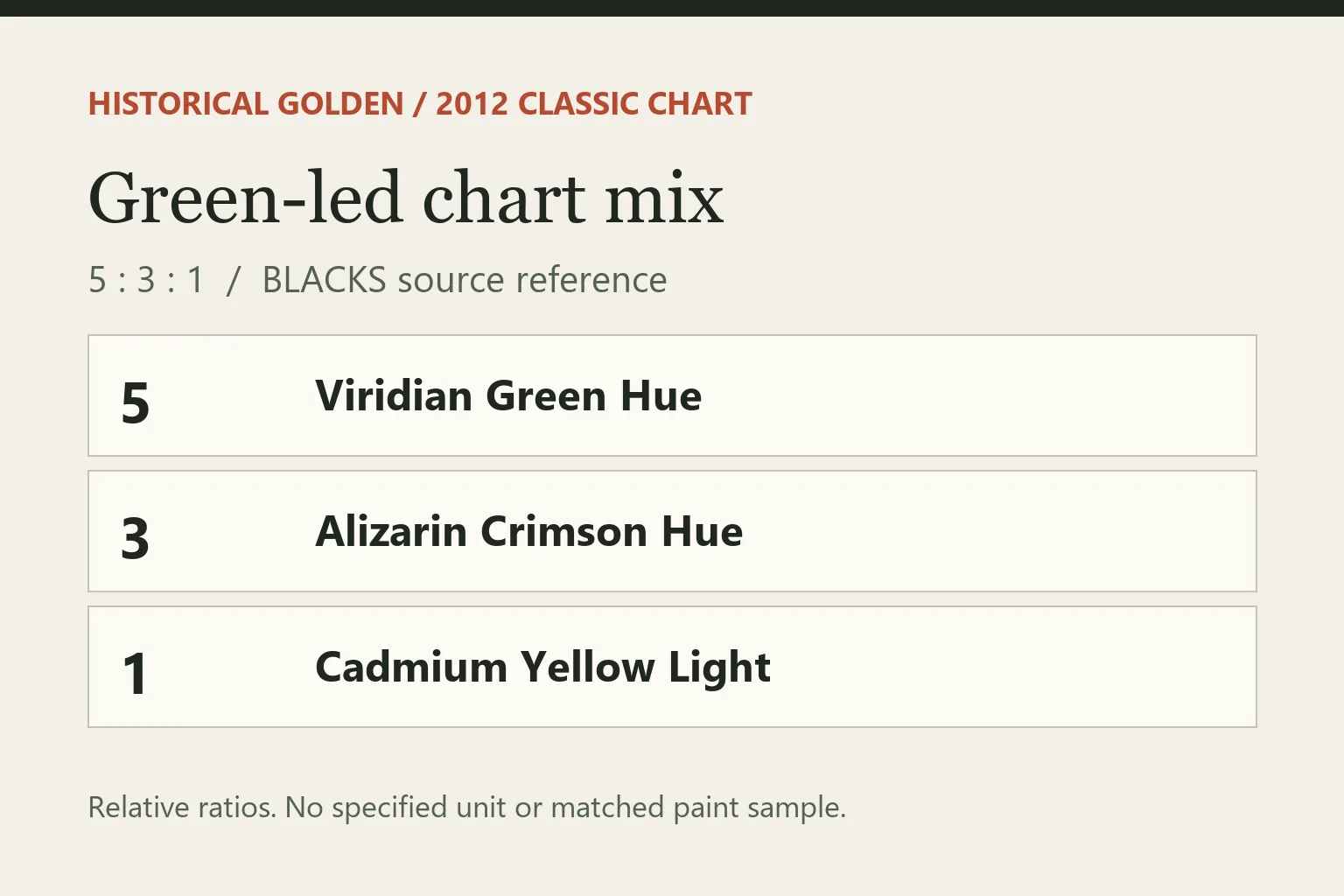
GOLDEN’s ©2012 Classic color mixing poster shows Viridian Green Hue 5 : Alizarin Crimson Hue 3 : Cadmium Yellow Light 1 in its bottom BLACKS block, bottom row, left swatch. The numbers total 9 relative quantities. The poster supplies a ratio without drops, grams, volumes or a measurement protocol. “Green-led” describes the largest ingredient ratio here; it is not a manufacturer name or a prediction of the mixed color.
Start here
What is the green-led 5:3:1 chart reference?
In ingredient order, the historical row gives 5 Viridian Green Hue, 3 Alizarin Crimson Hue and 1 Cadmium Yellow Light: 9 relative quantities in total. Doubling all three numbers gives 10:6:2, totaling 18 relative quantities. This preserves the ratio without defining a physical batch or demonstrating a paint result.
©2012 Classic chart · BLACKS
Green-led reference · 5:3:1
Historical names and relative ratios from the poster. Total: 9 relative quantities; physical units are unspecified.
| Ingredient | Relative ratio |
|---|---|
| Viridian Green Hue | 5 |
| Alizarin Crimson Hue | 3 |
| Cadmium Yellow Light | 1 |
GOLDEN documents a composition change to Alizarin Crimson Hue. Present-day bottle information does not establish the formulations represented by this 2012 row.
01
Find the bottom-left BLACKS swatch
Open the single-page poster linked below and find the bottom BLACKS block. Use the left swatch in its bottom row. The printed notation is VGH 5 : ACH 3 : CYL 1, expanded in the table above as Viridian Green Hue, Alizarin Crimson Hue and Cadmium Yellow Light.
Keep the block, row and ingredient order in your notes. BLACKS is the poster’s section label; it does not establish that a present-day trial makes a particular black or a named commercial color. Green-led is an editorial description of the ratio’s largest component, not an output-color claim.
02
Check the historical boundary before selecting bottles
GOLDEN’s July 22, 2024 COLOR BLEND CHANGES update documents a composition change to Alizarin Crimson Hue. The same notice documents the Indian to India Yellow Hue rename and a composition change to that yellow, relevant to the companion white-led row. Keep those facts attached to the appropriate ingredients rather than assuming all chart names identify unchanged paints.
Retain Alizarin Crimson Hue as the historical chart name. For a new trial, record the actual bottles and ranges you select, including label details you can read. A current pigment list or product number does not prove what was in the 2012 paints. This guide does not establish historical formulations for any of the three ingredients or guarantee a present-day match.
03
Double 5:3:1 to 10:6:2
First check the original total: 5 + 3 + 1 = 9 relative quantities. Multiply each number by two to get Viridian Green Hue 10, Alizarin Crimson Hue 6 and Cadmium Yellow Light 2. Their sum is 18. The ingredient relationship remains 5:3:1 because every component received the same multiplier.
This is a scaling example for the printed numbers. It is not a measured batch, a coverage estimate or a manufacturer measuring instruction. The poster supplies no drops, mass, volume or preparation protocol, and no dilution formula. If you choose a physical measuring basis for your own trial, state it explicitly in that trial instead of assigning it retrospectively to the poster.
04
Keep a trial record alongside the source
Save a source entry such as “Classic BLACKS / bottom row / left swatch / VGH 5 : ACH 3 : CYL 1 / ©2012,” with the poster link. Then create a separate “Green-led trial 01” entry for your chosen materials. Record their full identities, your measuring basis, planned and actual additions, and any uncertainty. Preserve the original reference if you later change one ingredient.
A second entry can record one deliberate change while keeping the first attempt available for comparison. Describe any application and viewing conditions you actually use, then write what you observe. Do not fill the result field from a diagram or video. This note structure is a practical suggestion; Mix Therapy has not performed or verified a physical mixing experiment for this guide.
05
Separate illustrations and tool suggestions from evidence
The numerical hero diagram makes the ratio readable without claiming a paint appearance. Any accompanying AI-generated mixing video is an illustration, not measured paint, a physical swatch or a tested match. Neither establishes how your selected bottles will look together.
Use the general workbench separately if you want to explore a target with paints you select. This guide’s link does not preload the exact historical paints or the 5:3:1 ratio. Save any suggested mixture as its own exploration rather than calling it a reconstruction of the Classic chart row.
Free studio printables
Record the test instead of guessing again.
Use the worksheet beside the palette, then keep the dry result with the painting notes. Each PDF is free, low-ink and formatted for US Letter paper.
See both printables and the full methodSources and product references
- GOLDEN: Classic color mixing poster (©2012) — Single page, bottom BLACKS block, bottom row, left swatch: VGH 5 : ACH 3 : CYL 1.
- GOLDEN: product discontinuations and color blend changes — July 22, 2024 COLOR BLEND CHANGES update documents composition changes to Alizarin Crimson Hue and India Yellow Hue, plus the yellow’s rename.
Studio questions
Questions painters ask
Does 5:3:1 mean five, three and one drops?
No drop unit is given. These are relative ratios; a physical measuring basis would belong to a separately documented trial.
Does the BLACKS heading guarantee a black with my paints?
No. It locates the historical row. This guide establishes no physical result with your materials.
Does today’s Alizarin Crimson Hue establish the 2012 formulation?
No. GOLDEN documents a composition change, and current bottle information does not identify the historical formulation.