
Historical chart reference
GOLDEN Classic chart: a white-led 10:3:1 mix
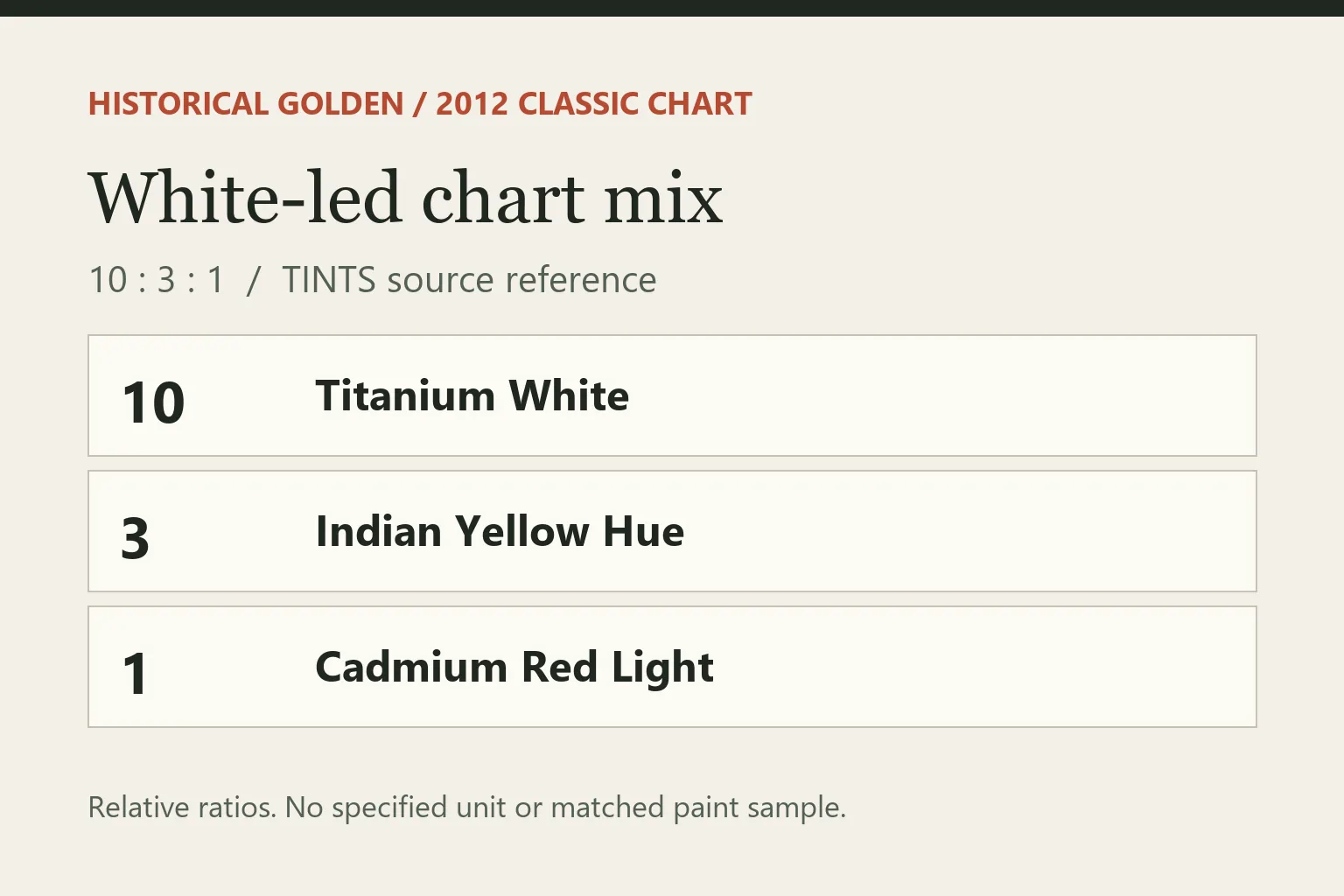
GOLDEN’s ©2012 Classic color mixing poster shows Titanium White 10 : Indian Yellow Hue 3 : Cadmium Red Light 1 in its bottom TINTS block, top row, third swatch from the left. The numbers total 14 relative quantities. They are a ratio reference: the poster does not specify drops, grams, volumes or a measurement protocol. “White-led” describes this guide’s ingredient relationship, not a manufacturer-named mixed color.
Start here
What does the white-led 10:3:1 row mean?
Read the historical ingredients in order: 10 Titanium White, 3 Indian Yellow Hue and 1 Cadmium Red Light. Their relative quantities add to 14. Multiplying every number by two gives 20:6:2, totaling 28 relative quantities. This arithmetic does not establish a physical batch size, coverage or a way to measure the paint.
©2012 Classic chart · TINTS
White-led reference · 10:3:1
Historical names and relative ratios from the poster. Total: 14 relative quantities; physical units are unspecified.
| Ingredient | Relative ratio |
|---|---|
| Titanium White | 10 |
| Indian Yellow Hue | 3 |
| Cadmium Red Light | 1 |
Keep the historical spelling Indian Yellow Hue in this reference. Current India Yellow Hue has a documented rename and composition change; its present formulation is not established as the 2012 paint.
01
Locate the exact row on the poster
Open the single-page Classic color mixing poster in the references below. Find the bottom TINTS block, then the third swatch from the left in its top row. Its printed notation is TW 10 : IYH 3 : CRL 1. The ingredient table above expands those abbreviations while retaining the historical names and numbers.
Record the block and position along with the ratio. A note that says only “10:3:1 from the chart” loses the ingredient order and makes another row easy to confuse with this one. This reference belongs to TINTS; do not locate it in BLACKS. The guide title is an editorial description, not an additional product name from the poster.
02
Keep historical and current materials distinct
GOLDEN’s product-discontinuation notice, in its July 22, 2024 COLOR BLEND CHANGES update, documents the rename from Indian Yellow Hue to India Yellow Hue and a composition change to India Yellow Hue. It also documents a composition change to Alizarin Crimson Hue, which appears in the companion green-led reference. A renamed ingredient cannot be treated as unchanged on the strength of its name.
For this row, retain Indian Yellow Hue in the source record. If you choose a present-day bottle for a trial, record the full name and range on that bottle separately. Current bottle pigments or product numbers do not establish the formulations represented by the 2012 poster. This guide supplies no historical-to-current equivalence or guaranteed replacement.
03
Scale the relationship without inventing units
Start with 10 + 3 + 1 = 14 relative quantities. Double each ingredient in order: Titanium White 20, Indian Yellow Hue 6 and Cadmium Red Light 2. The check is 20 + 6 + 2 = 28. Both 10:3:1 and 20:6:2 express the same proportional relationship; increasing only one number changes that relationship.
Neither total is a measured amount of paint. The poster provides no physical units or measurement protocol, so the numbers cannot be relabeled as drops, grams or milliliters on its authority. It also gives no prepared-paint dilution formula. A chosen measuring basis would be part of your own trial method, not a manufacturer instruction established by this chart.
04
Save the reference before choosing a trial
A useful reference entry is “Classic TINTS / top row / third from left / TW 10 : IYH 3 : CRL 1 / ©2012,” followed by the poster link. Keep that entry unchanged. In a separate entry such as “White-led trial 01,” list the actual bottles you choose, the date, your measuring basis, planned and actual additions, and any unresolved ingredient identity.
If you use current India Yellow Hue, name it as the material you chose rather than silently editing the historical reference. Record any other additions separately. Leave the observation field blank until you have something of your own to inspect; neither the chart ratio nor this guide establishes the appearance or coverage of that trial. These are suggested recording practices, not a report of painting or mixing performed by Mix Therapy.
05
Use the diagram and general workbench separately
The neutral diagram explains the numbers only. Any accompanying AI-generated mixing video is an illustration, not measured paint, a physical swatch or evidence of a match with the poster. Keep those images separate from observations of your chosen materials.
The general Mix Therapy workbench can support a separate exploration with a target and paints you select. The link below does not preload these exact historical paints or the 10:3:1 ratio. Keep any tool suggestion in its own record; it does not reconstruct the historical row.
Free studio printables
Record the test instead of guessing again.
Use the worksheet beside the palette, then keep the dry result with the painting notes. Each PDF is free, low-ink and formatted for US Letter paper.
See both printables and the full methodSources and product references
- GOLDEN: Classic color mixing poster (©2012) — Single page, bottom TINTS block, top row, third swatch from the left: TW 10 : IYH 3 : CRL 1.
- GOLDEN: product discontinuations and color blend changes — July 22, 2024 COLOR BLEND CHANGES update: Indian to India Yellow Hue rename and composition changes to India Yellow Hue and Alizarin Crimson Hue.
Studio questions
Questions painters ask
Are the numbers drops or grams?
Neither unit is specified. The poster prints a relative ratio without physical units or a measurement protocol.
Can I follow the historical row with current India Yellow Hue?
You can choose it for a separately recorded trial. The documented rename and composition change mean this guide does not establish equivalence to the historical ingredient.
Is the mixed color called White-led?
No. White-led is this guide’s descriptive title. The poster does not assign this swatch a commercial output name.