
Manufacturer recipe reference
GOLDEN High Flow Burnt Sienna Hue: the drop recipe
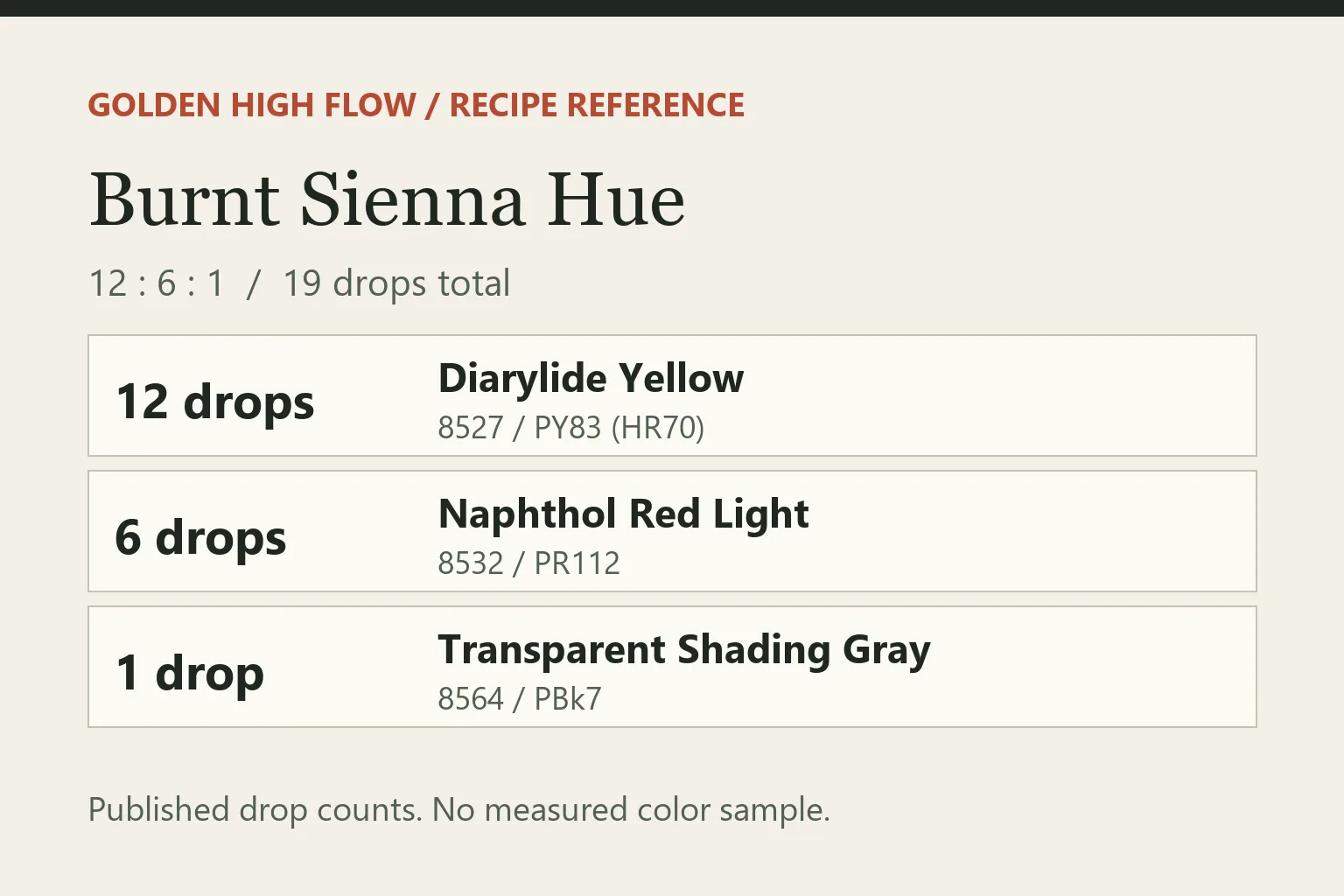
GOLDEN’s High Flow resource lists Burnt Sienna Hue as 12 drops Diarylide Yellow, 6 drops Naphthol Red Light and 1 drop Transparent Shading Gray: 19 drops altogether. The resource gives mixtures for recreating discontinued Airbrush colors with High Flow paints. This page keeps that specific drop recipe separate from substitutions, screen colors and the illustrative video.
Start here
What is the published drop recipe?
Use the three High Flow products in the table: 12 yellow drops, 6 red drops and 1 shading-gray drop. The total is 19 drops. Keep drops as the measurement basis; this reference supplies no conversion to grams, milliliters or scoops.
GOLDEN High Flow ingredients
Burnt Sienna Hue · 19 drops total
Product numbers and pigment codes identify the bottles alongside the drop count.
| Ingredient · product · pigment | Drops |
|---|---|
| Diarylide Yellow · 8527 · PY83 (HR70) | 12 |
| Naphthol Red Light · 8532 · PR112 | 6 |
| Transparent Shading Gray · 8564 · PBk7 | 1 |
Use the named High Flow products. A shared pigment code alone does not establish that a different paint is interchangeable.
01
Check the bottles before counting
Put the three bottles beside the recipe before preparing a container. Read the complete name and paint range, then compare the product number with the table. Copy those identifiers into your notes. This is a useful stopping point if a label is unclear: resolve the ingredient identity before spending paint on a mixture whose starting materials are uncertain.
Keep the source recipe as a separate line above your own observations. Give the trial a short identifier, such as BS-01, and a date. Leave space for planned counts, actual counts and any later additions. A note headed only “brown” or “burnt sienna” will not tell you which recipe you followed when you return to it.
02
Use the specific shading gray
Transparent Shading Gray is product 8564, with PBk7 pigment. GOLDEN describes its pigment loading as lower than Carbon Black’s. The cited information supplies no dilution ratio for making it from Carbon Black, so do not assume one drop of either product is equivalent or invent a water-to-paint conversion.
If you do not have the specified gray, keep the published recipe intact in your notes and label any alternative as a new trial. Write the replacement’s full identity and actual amount. That makes it possible to distinguish “I followed this reference” from “I explored another ingredient,” without losing either record.
03
Make a small, traceable trial
For a first attempt, use one complete 19-drop recipe rather than committing to a large batch. Follow each bottle’s preparation and handling instructions. Use a clean container with room to mix, keep the ingredients identifiable, and count one bottle at a time. Mark each completed count immediately instead of relying on memory after all three additions.
Keep the drop-dispensing approach as consistent as you can and describe what you used. The count is a practical record of this trial; it does not establish a measured mass or volume. If you lose count, mark the uncertainty rather than writing the planned number as though it were observed. A fresh small attempt can be easier to interpret than an undocumented correction.
Mix the additions together, then make a small labeled application on a spare piece of your intended surface. Record the ground, application method and any added material separately. Keep an unmodified sample before exploring adjustments. These are suggested recording steps, not experiments performed by Mix Therapy or a claim about how your sample will look.
04
Double every drop count together
For a doubled trial, the arithmetic is 24 yellow drops, 12 red drops and 2 shading-gray drops, totaling 38. Every count has been multiplied by two. This preserves the published count relationship while making the planned quantity explicit. Check the sum before dispensing, and write the new planned counts beside the actual additions.
Choose a whole-number multiplier when you want whole drops. Halving the original recipe would call for half of the gray drop, which this counting method does not resolve. Do not round that addition away and still call the result the same recipe. Nor does a total of 38 drops tell you a batch’s weight, measured volume or coverage.
If a project needs a particular amount in grams, establish a separately measured trial and record its measurement basis. Do not simply rename the drop counts as grams. The related scaling guide explains proportional arithmetic more generally; the worked example here deliberately stays with the original drop-count basis.
05
Handle a counting error explicitly
Suppose you intended one recipe but counted two shading-gray drops after already adding the planned yellow and red. To restore the arithmetic relationship by addition, the total counts would need to become 24 yellow, 12 red and 2 gray. That means adding another 12 yellow and 6 red drops, producing 38 drops altogether.
This is a hypothetical counting example, not a tested rescue procedure or a promise about appearance. Decide whether a doubled batch is useful before adding more. If the count itself is uncertain, the calculation cannot resolve that uncertainty. Keep the uncertain attempt labeled and consider starting a fresh small trial with a clear tally.
06
Keep the reference separate from your result
Beside the labeled application, record what you actually observe after it dries and the light used for comparison. Write specific observations such as “compared with my reference under the desk lamp,” followed by your own description. Leave the observation blank until you have made it. A useful trial record distinguishes a planned outcome from something you saw.
If you change an ingredient or add another color, begin a new labeled entry and retain the original sample. Write each addition and the reason for it. Compare the two records under the same chosen conditions. This keeps a personal adjustment from silently replacing the manufacturer reference when you later share or repeat the recipe.
The accompanying AI-generated video is illustrative. Its color and mixing sequence are not a measured swatch, a physical paint test or evidence of a color match. Use the page as a recipe reference and your own labeled application as the record of your actual materials.
Troubleshooting
Resolve the record before changing the mixture
These checks help identify what is known about a trial.
| Question | Next step |
|---|---|
| A bottle has a similar name | Check its full product identity against the ingredient table. |
| The gray is unavailable | Label a replacement as a separate trial; retain the source recipe. |
| The drop count was lost | Mark it uncertain rather than copying the planned count. |
| You need more paint | Multiply every count by the same whole number. |
| The video looks different | Compare your recorded physical application with your own reference. |
Free studio printables
Record the test instead of guessing again.
Use the worksheet beside the palette, then keep the dry result with the painting notes. Each PDF is free, low-ink and formatted for US Letter paper.
See both printables and the full methodSources and product references
- GOLDEN: High Flow Acrylic Colors — Published recipe and context for recreating discontinued Airbrush colors.
- GOLDEN: High Flow pigment data — Ingredient product numbers and pigment identities.
- GOLDEN: Transparent Shading Gray — Specific gray product. The lower-pigment comparison appears in the High Flow resource above.
Studio questions
Questions painters ask
Can I use another paint with the same pigment code?
Treat that as a separate trial. Copy its full product identity and actual additions into a new record rather than claiming that you followed the published ingredient list.
How much does the doubled recipe make?
The planned count is 38 drops: 24 yellow, 12 red and 2 gray. That arithmetic does not establish a measured weight, volume or coverage.
Does the video show a tested result?
No. The AI-generated video is illustrative. The reference identifies a published recipe; your own labeled physical trial records what happens with your materials.
Will the workbench load this recipe?
No. The general workbench does not preload these exact High Flow products or the 12:6:1 recipe. Keep this reference available separately when following the drop counts.