
Historical manufacturer recipe reference
GOLDEN Raw Umber Hue: the historical High Flow recipe
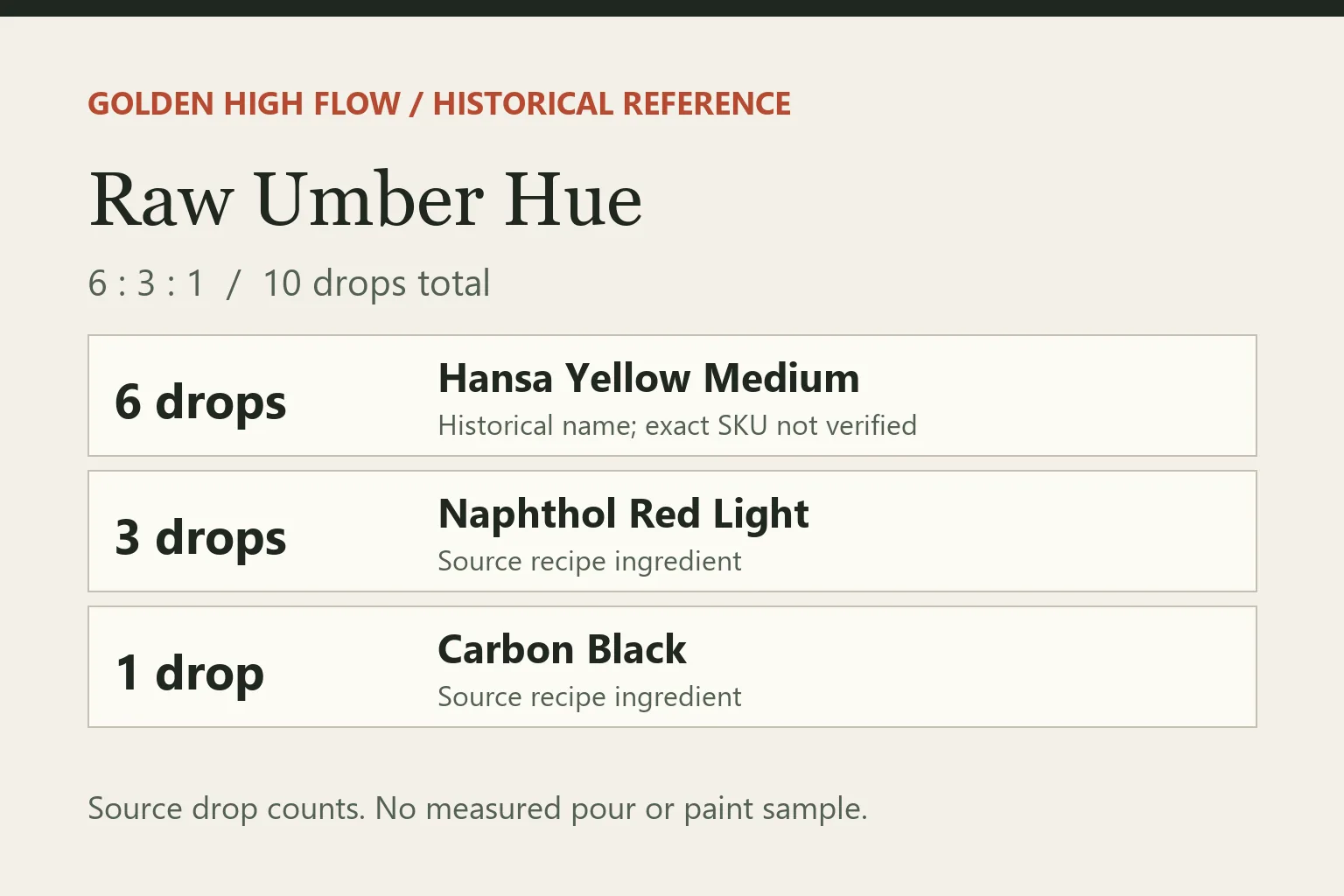
GOLDEN’s High Flow resource lists Raw Umber Hue as 6 drops Hansa Yellow Medium, 3 drops Naphthol Red Light and 1 drop Carbon Black: 10 drops total. It appears in a recipe guide for recreating discontinued Airbrush colors. Keep this as a historical starting reference. The current High Flow pigment chart does not establish the historical Hansa Yellow Medium product or its pigment, so identifying that ingredient remains a separate task before claiming to follow the recipe.
Start here
What is the Raw Umber Hue drop recipe?
The published count relationship is 6 yellow : 3 red : 1 black, totaling 10 drops. Doubling every count gives 12 : 6 : 2, totaling 20 drops. These are drop counts, with no conversion to mass, measured volume or scoops. If the historical yellow cannot be identified, preserve the reference and label a chosen replacement as a new trial.
Historical High Flow recipe
Raw Umber Hue · 10 drops total
Names and counts from GOLDEN’s recipe for recreating a discontinued Airbrush color. Historical product identity still needs checking.
| Ingredient | Drops |
|---|---|
| Hansa Yellow Medium | 6 |
| Naphthol Red Light | 3 |
| Carbon Black | 1 |
The source spells the red “Napthol Red Light”; this page uses “Naphthol.” No historical product numbers or pigment codes are assigned here.
01
Read the recipe in its historical context
The manufacturer places this formula under recipes for recreating lost Airbrush colors with High Flow paints. That context matters: the row is a reference to a named historical color, rather than a general formula for every paint sold as raw umber. The same source also has a separate Transparent Raw Umber Hue entry. Keep the exact row name beside your counts so those two references do not become interchangeable in your notes.
A published recipe establishes what the manufacturer listed. It does not establish the identity of every bottle now on your shelf, a current shopping list or a match made with your materials. Begin by copying the reference into its own dated entry, with the source link. Leave a separate space for the ingredients you can actually identify and the observations you make yourself.
02
Resolve Hansa Yellow Medium before calling it a reproduction
Keep the name Hansa Yellow Medium exactly as given in the historical row. The current High Flow pigment-data page does not establish that historical product’s SKU or pigment. A pigment code attached to a similarly named paint in another GOLDEN range cannot fill that gap. Nor does a present-day chart prove the historical formulations of the red and black. For that reason, the ingredient table deliberately uses names without adding product numbers or pigment codes.
If you have an older bottle, record the complete label, paint range and any product information still readable. If its identity remains uncertain, retain that uncertainty in the record and seek manufacturer clarification before describing a mixture as a reproduction of the listed ingredients. This guide does not establish whether the legacy yellow is currently available.
If you choose a different yellow to continue exploring, write its actual full name and range in a new trial entry. Do not silently replace Hansa Yellow Medium with Benzimidazolone Yellow Medium or claim the two are equivalent. You can explore a new mixture while keeping the historical reference intact; the new trial simply answers a different question about the materials you chose.
03
Keep the count basis visible while you work
For an identified set of ingredients, a small trial can begin with one complete 10-drop count. Follow the bottles’ own preparation and handling instructions. Before dispensing, write three planned counts beside the ingredient names and leave a second column for actual additions. Count one ingredient at a time, then mark it complete. This makes an interruption easier to recover from than a single total written after everything is mixed.
Describe the dispensing approach you used and keep it consistent within the trial. Ten counted drops are not a measured pour volume or a known weight. Do not write grams or milliliters beside the numbers as though the units were interchangeable. If you add another material, identify it separately rather than hiding it within the three paint counts.
When a count is lost, mark it uncertain. Copying the intended count into the actual-count column would make the next comparison misleading. These are proposed recording practices, not a report of an experiment performed by Mix Therapy. They help preserve what you know even when an attempt does not go as planned.
04
Scale 6 : 3 : 1 to 12 : 6 : 2
Add the original counts first: 6 + 3 + 1 = 10 drops. A doubled count multiplies each ingredient by two: 12 yellow drops, 6 red drops and 2 black drops. Check the new total independently: 12 + 6 + 2 = 20. Increasing only the yellow would change the count relationship instead of scaling the whole recipe.
Choose whole-number multipliers when recording whole drops. Half of the original recipe would require half of the black drop, which a whole-drop tally does not resolve. Rounding it to zero would remove an ingredient. A 20-drop plan also does not establish coverage or how much space the paint occupies in a container.
If you need a recipe based on measured mass or volume, develop and label a separate trial with that basis. Keep the drop reference alongside it instead of relabeling the old numbers. The related scaling guide explains proportional arithmetic more generally; this example stays with the source’s drop counts throughout.
05
Version a substitution instead of rewriting the source
One useful note structure is a reference entry called RU-reference, followed by trial entries RU-01 and RU-02. In the reference, retain the published names and 6/3/1 counts. In RU-01, list the actual bottles, planned and actual counts, date, dispensing method and unresolved identities. If a yellow is substituted, put “alternative yellow trial” in the heading where you will see it when returning to the notes.
For RU-02, copy only the details that remain true and state the deliberate change. For example, you might choose another yellow while holding the planned count relationship constant. That is a proposal for organizing a comparison, not evidence that either choice produces a particular color. Keeping versions lets you compare your attempts without retroactively changing what the manufacturer published.
Before making adjustments, keep a labeled application of the initial trial on a spare piece of your intended surface. Record the surface, application and viewing conditions, then write your own observation when you inspect it. Describe what you see rather than filling in a predicted result. Retain earlier notes and samples if you later add paint or change an ingredient.
06
Use the illustration and workbench for their stated roles
The accompanying AI-generated pouring and mixing video is an illustration. It does not demonstrate measured drop counts, a physical paint swatch or a verified match. The count diagram on this page likewise explains the numbers rather than showing the appearance of mixed paint. Use your own labeled application to document the result of your chosen materials.
The general Mix Therapy workbench can be used separately with a reference target and the paints you select. Opening it from this guide does not preload the historical High Flow ingredients or the 6:3:1 recipe. Keep this reference available when consulting the published counts, and keep any workbench suggestion in its own record rather than treating it as a reconstruction of the historical formula.
Troubleshooting
Choose the next step from what is known
Keep the reference, ingredient identity and actual trial record distinct.
| Situation | Next step |
|---|---|
| The historical yellow cannot be identified | Keep the reference unchanged; seek clarification or label a replacement as a new trial. |
| A similar yellow appears in another paint range | Record its own full identity; do not infer historical equivalence. |
| The actual count is uncertain | Mark the uncertainty and consider a fresh small tally. |
| You want twice the planned count | Use 12 yellow, 6 red and 2 black drops: 20 total. |
| An illustration suggests a particular brown | Record your own physical observation; the illustration is not a swatch. |
Free studio printables
Record the test instead of guessing again.
Use the worksheet beside the palette, then keep the dry result with the painting notes. Each PDF is free, low-ink and formatted for US Letter paper.
See both printables and the full methodSources and product references
- GOLDEN: High Flow Acrylic Colors — Raw Umber Hue row in the recipe guide for recreating discontinued Airbrush colors; source of the drop counts and ingredient names.
- GOLDEN: High Flow pigment data — Current product chart, which does not establish the historical High Flow Hansa Yellow Medium SKU or pigment.
Studio questions
Questions painters ask
Can I use a different yellow?
You can choose one for a separately labeled trial. Retain Hansa Yellow Medium in the reference and record the replacement’s full identity; this guide establishes no equivalent substitute.
Is the 6:3:1 recipe measured in grams?
No. GOLDEN gives drops. The 10-drop total and doubled 20-drop total are counts, with no established conversion to grams or measured volume.
Does the current chart identify the historical yellow pigment?
No. It does not establish that historical High Flow product’s SKU or pigment. A similarly named product in another range is not sufficient evidence.
Does the video show a tested paint match?
No. It is AI-generated illustration of pouring and mixing, without measured counts or a verified physical swatch.