
Deep landscape green
How to mix forest green acrylic paint without black
Forest green is a deep, rich, low-value green that captures the cool shadow and living depth of dense woodland foliage. Mixing black directly into green flattens and deadens the color. A vibrant, atmospheric forest green is built by pairing high-chroma green with controlled warm and cool complementary darks.
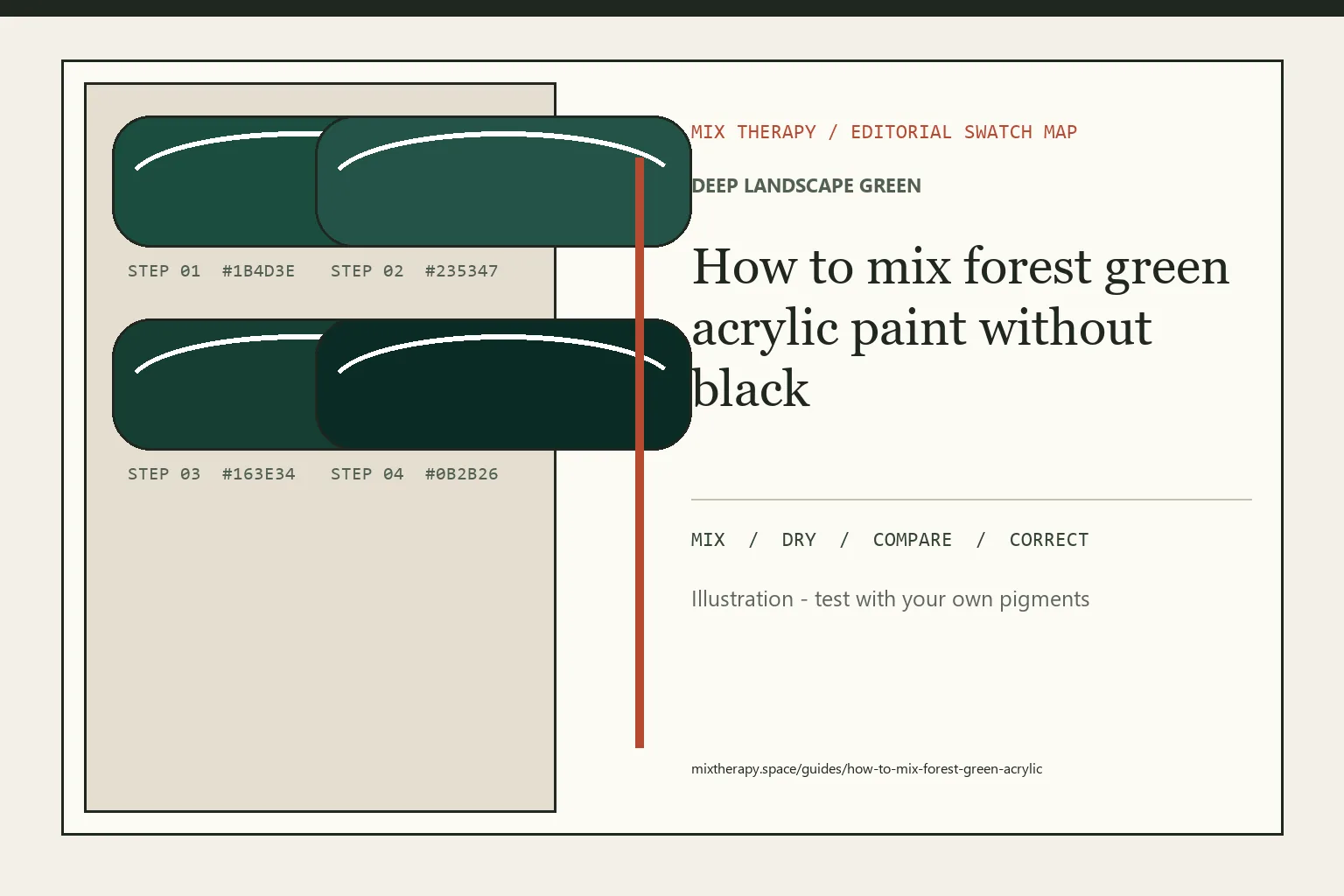
Start here
The short answer
To mix deep forest green without black, combine phthalo green with burnt sienna to neutralize its artificial neon intensity into a rich natural dark. Add ultramarine blue to cool the shadow into evergreen pine, or introduce yellow ochre for a warm sunlit moss undertone. Always test a thin drawdown to ensure the green undertone remains visible in deep values.
Forest palette ratios
Build chromatic foliage darks from complementary pairs
Burnt sienna grounds intense greens while preserving botanical vitality.
| Foliage tone | Character | Starting direction |
|---|---|---|
| Deep Forest Green | Dense canopy shadow | 60% Phthalo Green + 35% Burnt Sienna + 5% Ultramarine |
| Pine Needle Green | Cool evergreen needle | 50% Phthalo Green + 30% Ultramarine + 20% Burnt Sienna |
| Moss Shadow Green | Earthy forest floor | 45% Yellow Ochre + 35% Phthalo Green + 20% Burnt Umber |
| Sunlit Leaf Canopy | Warm filtered daylight | 50% Forest Base + 35% Yellow Ochre + 15% White |
Phthalo green is an aggressive staining pigment. Add it to burnt sienna in small knife-tip increments.
01
Understand why black destroys foliage vitality
Tube black contains dense carbon particles that absorb light uniformly, stripping greens of their natural chromatic vibration. In nature, deep forest foliage contains living chlorophyll and transmitted warm sunlight, meaning shadow areas remain richly connected to green and brown rather than lifeless gray.
By using burnt sienna as the primary neutralizer, you introduce warm red-orange pigments that cancel excess green chroma while simultaneously deepening value, creating a believable organic shadow that feels alive.
02
Tame high-chroma green with warm earth complements
Phthalo green (PG7 or PG36) is an exceptionally strong, cool, transparent green. On its own, it looks artificial and synthetic. When paired with burnt sienna (PR101 or PBr7), the red-orange complement immediately pulls the green into a dense, natural woodland hue.
Start by laying out a generous pile of burnt sienna, then fold in phthalo green a little at a time. Mix completely until the synthetic emerald tone softens into a deep cedar or hemlock green.
03
Steer temperature between cool pine and warm moss
Forests contain subtle temperature shifts. For cool evergreen trees like spruce and pine, add a touch of ultramarine blue or dioxazine violet. This shifts the dark toward a cool, receding shadow without turning gray.
For deciduous woodlands, forest floor moss or sun-dappled ferns, steer the mixture warmer by introducing yellow ochre or raw sienna. Yellow ochre introduces subtle golden warmth and opacity without causing mud.
04
Create value hierarchy for light and shadow passages
Do not lighten forest green by adding pure white alone. White turns deep greens into an opaque, chalky mint or seafoam tone. To raise value for sunlit foliage, add a premixed blend of titanium white and yellow ochre or lemon yellow.
Keep your darkest forest green reserved for deep branch junctions and core canopy shadows. Lighter leaves should carry higher chroma and warmth to simulate sunlight passing through translucent leaf tissue.
05
Test drawdown undertones and compensate for dry shift
Because forest green is a very low-value color, mass tone on the palette can deceive the eye and look almost black. Spread a thin film with your palette knife onto a white test strip to inspect the transparent undertone.
Acrylic binders dry darker and slightly cooler as they cure. Paint a swatch on your painting ground, let it dry under daylight, and compare it against your adjacent earth colors before applying it to your final canvas.
Troubleshooting
Fix common forest green mixing errors
Correct hue and temperature with complementary pairs rather than random tubes.
| Visible symptom | Underlying cause | Targeted correction |
|---|---|---|
| Looks like synthetic emerald | Not enough warm neutralizer | Add burnt sienna or warm red earth gradually. |
| Looks muddy and lifeless | Used black or too many pigments | Rebuild with clean phthalo green and burnt sienna. |
| Looks chalky and pastel | Added white directly to lighten | Add yellow ochre plus yellow before adding white. |
| Looks too blue or cold | Ultramarine or phthalo dominates | Introduce yellow ochre or warm raw sienna. |
Free studio printables
Record the test instead of guessing again.
Use the worksheet beside the palette, then keep the dry result with the painting notes. Each PDF is free, low-ink and formatted for US Letter paper.
See both printables and the full methodStudio questions
Questions painters ask
What colors make forest green acrylic paint?
Phthalo green mixed with burnt sienna and a touch of ultramarine blue produces a deep, natural forest green.
Can I use sap green for forest green?
Sap green is a convenient warm olive green, but it often lacks the deep shadow value needed for dark forest canopies. Deepening it with burnt sienna and ultramarine creates a true forest green.
Why does my green shadow look dirty?
Adding carbon black directly into green neutralizes chroma abruptly while creating a chalky gray undertone. Using complementary red-earths keeps shadows rich and organic.