
Natural foliage color
How to mix olive green acrylic paint
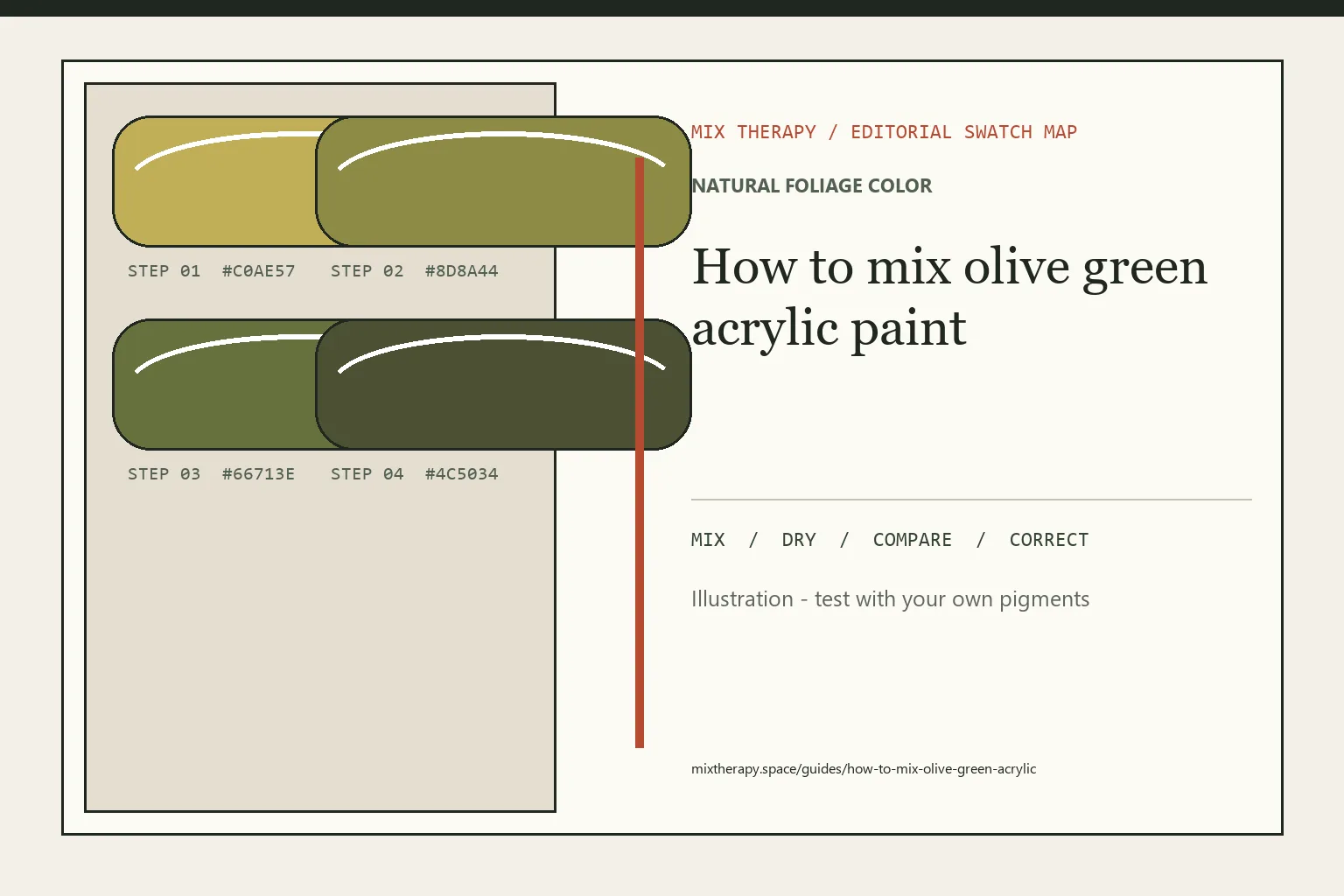
Olive green is a low-chroma yellow-green with an earthy bias. It is deeper and browner than sage, but it should still read clearly as green. Build the hue first, lower its chroma deliberately and create separate value families instead of darkening one pile with black.
Start here
The short answer
Mix a yellow-heavy green with yellow ochre or a warm yellow and a small amount of ultramarine blue. Add burnt sienna or burnt umber a trace at a time until the color becomes earthy. Use yellow and white for lights; deepen shadows with ultramarine and burnt umber while preserving a green undertone.
Olive controls
Adjust one property at a time
Olive can move from fresh leaf to deep military green without losing its yellow-green identity.
| Goal | Adjustment | Watch for |
|---|---|---|
| Warmer olive | More yellow ochre | Becoming plain ochre. |
| Cooler olive | Small blue addition | Turning pine green. |
| Earthier olive | Burnt sienna or umber | Collapsing into brown. |
| Lighter olive | Yellow, then white | A chalky gray-green. |
Mix a clean yellow-green first. Neutralizing before the green is established makes the final direction difficult to judge.
01
Choose the olive family you need
A sunlit olive leaf, canvas bag and military drab may all be called olive, but their value and chroma differ. Describe the target as light or dark, warm or cool, fresh or weathered before choosing paint.
Start from a midtone. It is easier to branch one controlled middle mixture into lights and shadows than to force a very dark pile upward with white.
02
Build a yellow-dominant green
Begin with yellow ochre for an immediately earthy base, or use a brighter yellow when the target needs more life. Add ultramarine in small increments. Its violet bias naturally restrains green compared with a cyan-biased phthalo blue.
If phthalo blue is the only blue available, make a small blue-yellow concentrate and pull tiny amounts into the yellow base. Its tinting strength can move olive into a cool forest green very quickly.
03
Lower chroma without erasing green
Burnt sienna is a useful neutralizer because its orange-red character opposes blue-green while staying related to many landscape palettes. Burnt umber deepens and mutes more quickly. Add either with the tip of a knife and mix completely.
Spread a thin sample after each addition. When the thin edge stops reading green, the mixture has crossed into brown. Restore it with clean yellow-green rather than adding more blue alone.
04
Mix separate light and shadow branches
For the light branch, add yellow before titanium white. Yellow preserves warmth and chroma while white raises value; using white alone can make olive look dusty. For dry, pale foliage, yellow ochre plus white may be appropriate.
For shadow, combine ultramarine and burnt umber separately, then introduce that dark into the olive base. This keeps control of value and temperature. Preserve reflected warm notes instead of making every shadow the same near-black.
05
Compare on the painting ground
Foliage greens are especially sensitive to surrounding sky, soil and warm light. Brush three close variations on the actual ground and let them dry. The most convincing olive is often not the closest isolated swatch but the one that fits the painting’s color family.
Save the base recipe and branch adjustments separately. A repeatable olive system is more useful than one large pile that changes every time a light or shadow is needed.
Troubleshooting
Steer olive back toward the target
Keep the yellow-green structure visible while changing value and chroma.
| Symptom | Likely cause | Correction |
|---|---|---|
| Looks like bright grass | Too much chroma | Add a trace of burnt sienna or warm earth. |
| Looks brown | Neutralizer overshot | Restore with a clean yellow-green base. |
| Looks minty | Too much white or cool blue | Add yellow ochre and a trace of burnt sienna. |
| Shadow looks black | Darkened with black alone | Build a blue-brown dark and return some base olive. |
Free studio printables
Record the test instead of guessing again.
Use the worksheet beside the palette, then keep the dry result with the painting notes. Each PDF is free, low-ink and formatted for US Letter paper.
See both printables and the full methodStudio questions
Questions painters ask
What colors make olive green?
A yellow-heavy green plus a small warm neutral makes olive. Yellow ochre, ultramarine blue and burnt sienna are a dependable starting set.
What is the difference between olive and avocado green?
Olive is usually deeper, browner and more neutral. Avocado is generally lighter, warmer and more yellow.
Can I make olive green without black?
Yes. Use blue to deepen the green and burnt sienna or umber to lower chroma. This gives more adjustable shadows than black alone.